REREAL OS
File Explorer
Custom UI
Desktop Interface
App Launcher
3D Experience
Responsive System
Window System
Interactive Portfolio
Overview
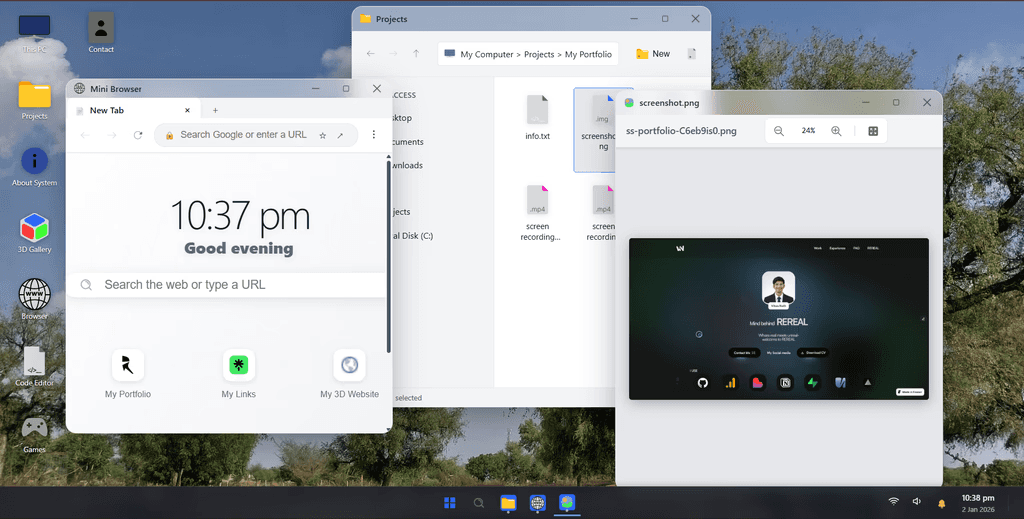
REREAL OS is a browser-based operating system inspired by the familiarity of modern desktop environments. Instead of presenting projects through conventional scrolling pages, the platform allows visitors to navigate an interactive workspace where projects, blogs, renders, applications, and creative experiments behave like native desktop software.
The goal of the project is not to recreate an operating system, but to rethink how digital portfolios can become experiences rather than websites. Every interaction is designed to encourage exploration, making visitors feel like they are using a real desktop instead of browsing a traditional portfolio.
Problem
Most portfolio websites follow a predictable structure consisting of a hero section, project cards, and long scrolling pages. While effective, these layouts rarely create memorable interactions or encourage visitors to spend time exploring the work.
For designers and developers who focus on building experiences, static layouts often fail to communicate creativity, technical ability, and product thinking.
Solution
REREAL OS transforms the portfolio into an interactive desktop environment where every project is presented as an application. Visitors can open windows, switch between content, explore folders, browse files, and navigate through different sections without leaving the desktop interface.
Rather than simply displaying projects, the platform recreates familiar desktop interactions inside the browser, making exploration intuitive while introducing a playful layer of immersion.
The experience combines interaction design, frontend engineering, and storytelling into a single cohesive product.
User Experience
From the moment the application loads, users are welcomed into a desktop-inspired environment instead of a standard homepage. Navigation happens naturally through windows, applications, taskbars, and familiar interface patterns that require almost no learning.
Projects become applications, blogs become documents, galleries become folders, and every interaction contributes to a continuous exploration experience.
Responsive layouts ensure the experience remains usable across different screen sizes while preserving the feeling of working inside a desktop operating system.
The interface is intentionally designed to reward curiosity by encouraging users to discover features rather than simply scroll through content.
Architecture & Development
REREAL OS is built using React and JavaScript with a modular component architecture that separates the desktop environment, window manager, applications, navigation system, and content rendering into independent modules.
Three.js is used to enhance visual presentation where immersive graphics improve the experience, while custom UI systems recreate desktop behaviors such as movable windows, layered interfaces, and application-based navigation.
The project emphasizes reusable components, efficient state management, and scalable architecture so additional applications and portfolio modules can be integrated without redesigning the overall system.
Deployment on Vercel provides fast loading, reliable hosting, and seamless updates.
Challenges & Iterations
Building a browser-based desktop experience introduced significantly more complexity than developing a conventional portfolio.
One of the biggest challenges was designing a window management system that felt natural while remaining responsive across devices. Managing multiple interactive windows, preserving application states, and maintaining smooth performance required careful architectural planning.
Another challenge involved balancing creativity with usability. The interface needed to feel unique without sacrificing discoverability or overwhelming first-time visitors.
Numerous iterations focused on refining animations, improving interaction feedback, simplifying navigation, and ensuring the experience remained intuitive despite its unconventional layout.
Results & Impact
REREAL OS demonstrates how portfolios can evolve from static showcases into fully interactive digital experiences. Instead of asking visitors to read about projects, the platform encourages them to explore them through direct interaction.
The project highlights frontend engineering, interface architecture, interaction design, component systems, and creative problem-solving while showcasing an alternative approach to portfolio design.
More importantly, it communicates the philosophy behind my work—that memorable products are created through experiences, not just interfaces.
What I Learned
Developing REREAL OS significantly improved my understanding of interface architecture, reusable component systems, interaction design, browser-based desktop environments, state management, performance optimization, and immersive frontend development.
The project reinforced the importance of designing interfaces that encourage exploration while maintaining clarity and usability. It also demonstrated how familiar interaction patterns can be reimagined to create engaging digital experiences without increasing user complexity.
Future Roadmap
Future versions of REREAL OS will introduce a fully functional terminal, customizable themes, persistent desktop sessions, integrated AI assistant, notification system, drag-and-drop file management, multiplayer collaboration spaces, additional creative applications, browser-based mini tools, and deeper Three.js integrations.
The long-term vision is to transform REREAL OS into a complete browser-native creative workspace where visitors can not only explore my portfolio but also interact with the tools, experiments, and ideas that define my work.
Note :
REREAL OS is an independent portfolio experiment built to explore immersive user interfaces and interaction design. It reimagines how creative work can be presented inside the browser and is intended for portfolio and educational purposes.
View Live App
Live Website